
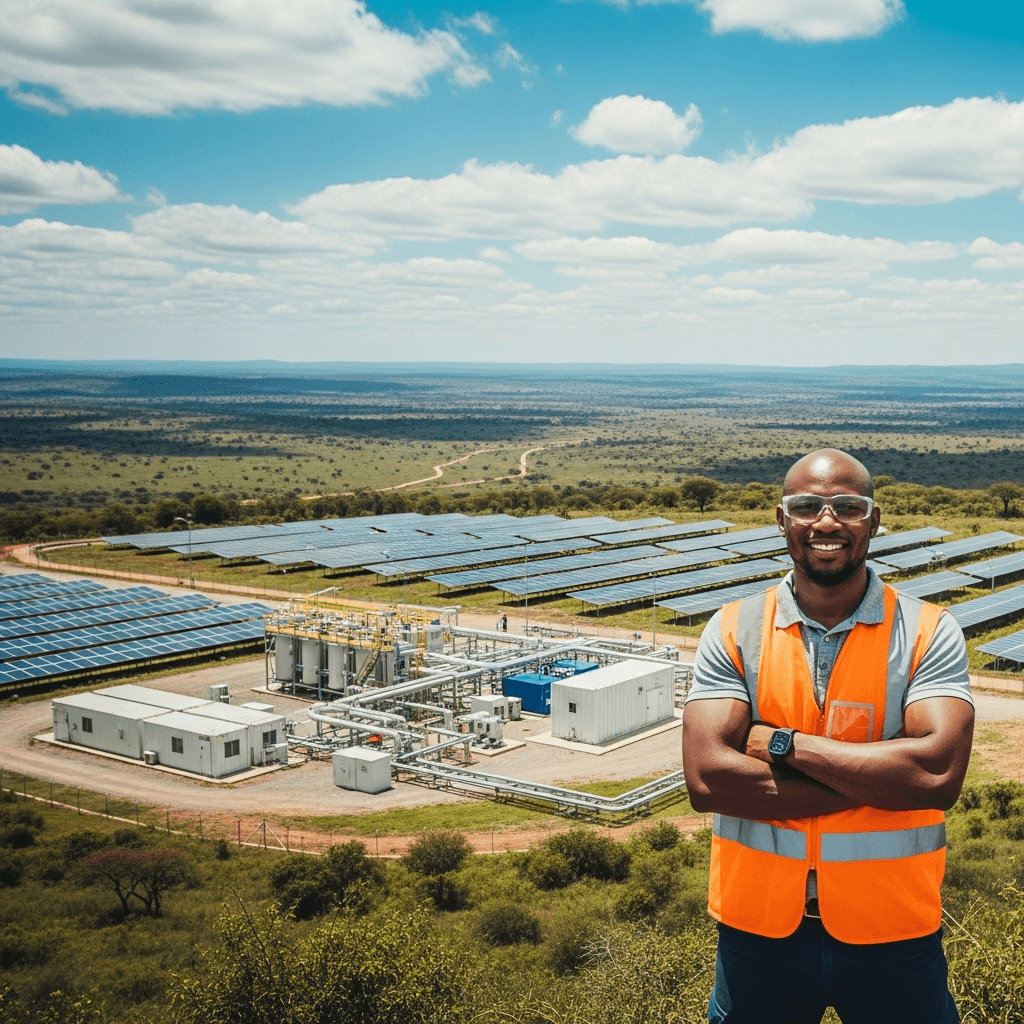
1. Introduction
Across many African countries, power systems remain unstable, with frequent blackouts and voltage fluctuations. This instability forces critical facilities such as hospitals, universities, telecom hubs, and industrial plants to depend heavily on diesel generators. In Nigeria alone, diesel often supplies more than half of the electricity in large campuses and medical institutions, contributing to high operational costs, pollution, and equipment degradation.
Over the last decade, solar photovoltaic (PV) systems have rapidly expanded as solar panel costs declined and awareness of renewable options increased. Solar alone, however, cannot provide round-the-clock electricity. To compensate for the intermittency, systems typically pair solar with battery energy storage. This combination has become the standard solution in homes, offices, and small commercial installations.
Yet as loads grow and reliability requirements become stricter, especially for large facilities above one megawatt demand, the limitations of battery-only systems begin to show. The most serious of these limitations is the inability of batteries to sustain multi-day periods of low sunlight, which are common across many countries and regions with long rainy seasons. Hydrogen therefore emerges as a complementary technology that provides the missing link: long-duration energy storage capable of replacing diesel.
This report evaluates the strengths and weaknesses of solar-battery systems and explains how hydrogen completes the system architecture by covering long-duration storage needs, improving battery life, and enabling heat recovery for greater overall efficiency. The report shows why hydrogen is not a competitor to batteries but a partner that strengthens solar infrastructure, reduces dependence on diesel, and enhances the resilience of energy systems across Africa.
2. The Challenge with Battery-Only Solar Systems
2.1 Seasonal and Multi-Day Cloudiness in African Climates
Southern Nigeria, much of West Africa, East Africa, and central regions of the continent experience long rainy seasons, with extended periods of cloud cover and reduced solar irradiance. It is common to have:
- several consecutive days with deep cloudiness
- entire weeks with suppressed solar generation
- long nights combined with poor morning irradiance
- seasonal variability that reduces output by 40–60%
Batteries lose effectiveness during these periods because they depend on daily solar input to recharge. Even systems sized to match annual electricity consumption struggle when sunlight drops for several days.
A typical solar-battery system can supply around 50–60% of total annual energy without excessive oversizing. Attempting to cover 100% of energy needs requires massive battery banks that become uneconomical. In practice, diesel generators fill the remaining 40–50%, especially during cloudy periods.
2.2 Depth-of-Discharge Stress and Battery Wear
For round-the-clock facilities, batteries cycle deeply every night. During rainy seasons, they may reach very low state-of-charge levels, sometimes approaching zero before the next charge period. Repeated deep discharges sharply reduce the lifespan of lithium-ion batteries.
Many commercial users replacing entire battery banks every five to seven years do so because their systems operate without an auxiliary long-duration backup source. The economics deteriorate quickly when both solar production decreases and battery stress increases.
2.3 Nighttime and Peak Load Challenges
Batteries shine in short-duration storage: managing hourly load variations, evening peaks, and the day-night cycle. But in large systems with consistent 24-hour loads, the gap between daytime solar production and nighttime demand becomes too wide. If cloudy conditions coincide with high demand, there is no affordable way for a battery-only system to remain autonomous for two to five days.
Facilities such as hospitals, ports, universities, greenhouse clusters, and manufacturing plants require stability. Once batteries reach critically low charge levels, diesel generators take over. This is where hydrogen becomes transformative.
3. The Role of Hydrogen as Long-Duration Storage
Hydrogen storage is suited for situations where batteries become too large or too expensive. It fulfils the part of the energy ecosystem that has no viable alternative in renewable systems: multi-day or weekly energy autonomy.
Hydrogen produced during sunny periods can be stored and later reconverted to electricity using a fuel cell when solar output is low and batteries are depleted. This allows a system to ride through extended periods of cloudiness without diesel.
3.1 Complementarity, Not Competition
Hydrogen does not replace batteries. They serve different time horizons:
- Batteries: minutes to hours
- Hydrogen: hours to days to weeks
A balanced system uses:
- Solar PV as the main source of generation
- Batteries for short-term balancing
- hydrogen for long-duration gaps
The result is a fully renewable architecture that operates in synergy.
Why Hydrogen Complements Batteries
Hydrogen fills the exact gap batteries cannot fill: duration.
Batteries are excellent for:
- smoothing second-to-second variations
- covering evening peaks
- shaving short-term loads
- responding instantly to power drops
Hydrogen is excellent for:
- supplying energy for multiple days
- bridging low-sun periods
- long-term storage without losing energy
- supporting the battery and extending its life
- Replacing diesel as the ultimate backup
Together, they create a stable, flexible, renewable system.
4. Advantages of solar-battery-hydrogen system Vs solar-battery system
4.1 Battery Longevity
With hydrogen keeping batteries within a healthier state-of-charge range, depth-of-discharge cycles become shallower. This dramatically slows capacity fade. A good lithium-ion battery with 6,000 cycles can stretch to 10,000+ shallow cycles when never allowed to fully drain.
Furthermore, a key benefit appears in integrated systems. During prolonged cloudy periods, the fuel cell can top up the battery to keep its state of charge high. This prevents the deep discharges that normally accelerate battery degradation.
Where a battery-only system may need replacement after 5–7 years, a hybrid solar-battery-hydrogen system can extend battery life to 12–15 years, significantly reducing lifecycle costs. This means fewer battery replacements and lower lifecycle CAPEX.
4.2 Reduced Use of Diesel Generators
In many African hospitals and campuses, diesel generators run:
- every night
- during cloudy days
- during grid outages
- during peak periods
A hydrogen-integrated system can cut diesel use by 80–95%, depending on sizing, because:
- batteries handle daily cycles
- hydrogen covers cloudy-day cycles
- cogeneration reduces LPG and diesel for heat
- solar covers the majority of daylight consumption
This shifts facilities away from fossil fuel dependence.
5. Conclusion
A solar-battery-hydrogen system provides a practical and resilient solution to the energy challenges facing large consumers in Africa. Batteries alone are not enough to guarantee multi-day reliability during cloudy weather or seasonal drops in solar generation. When batteries operate without long-duration support, they degrade quickly and leave facilities dependent on diesel during cloudy spells or at night.
Hydrogen offers a way to break this cycle. By acting as long-duration storage, it eliminates the need for oversized battery banks and replaces the role currently played by diesel generators. In large facilities, the co-generation benefits further improve overall efficiency and reduce operating costs. Hydrogen does not compete with batteries but instead strengthens the entire renewable energy system by covering the longest-duration gaps that cannot be handled economically by any other technology.
The combination of solar, battery storage, and hydrogen is therefore a credible pathway for achieving 24/7 renewable power in Africa’s most critical facilities. It provides stability, reduces diesel dependence, enhances battery lifespan, and improves total system efficiency. This integrated architecture allows renewable energy systems to operate reliably throughout cloudy days, long rainy seasons, and night-time hours, establishing a new model for resilient clean energy infrastructure across the continent.