
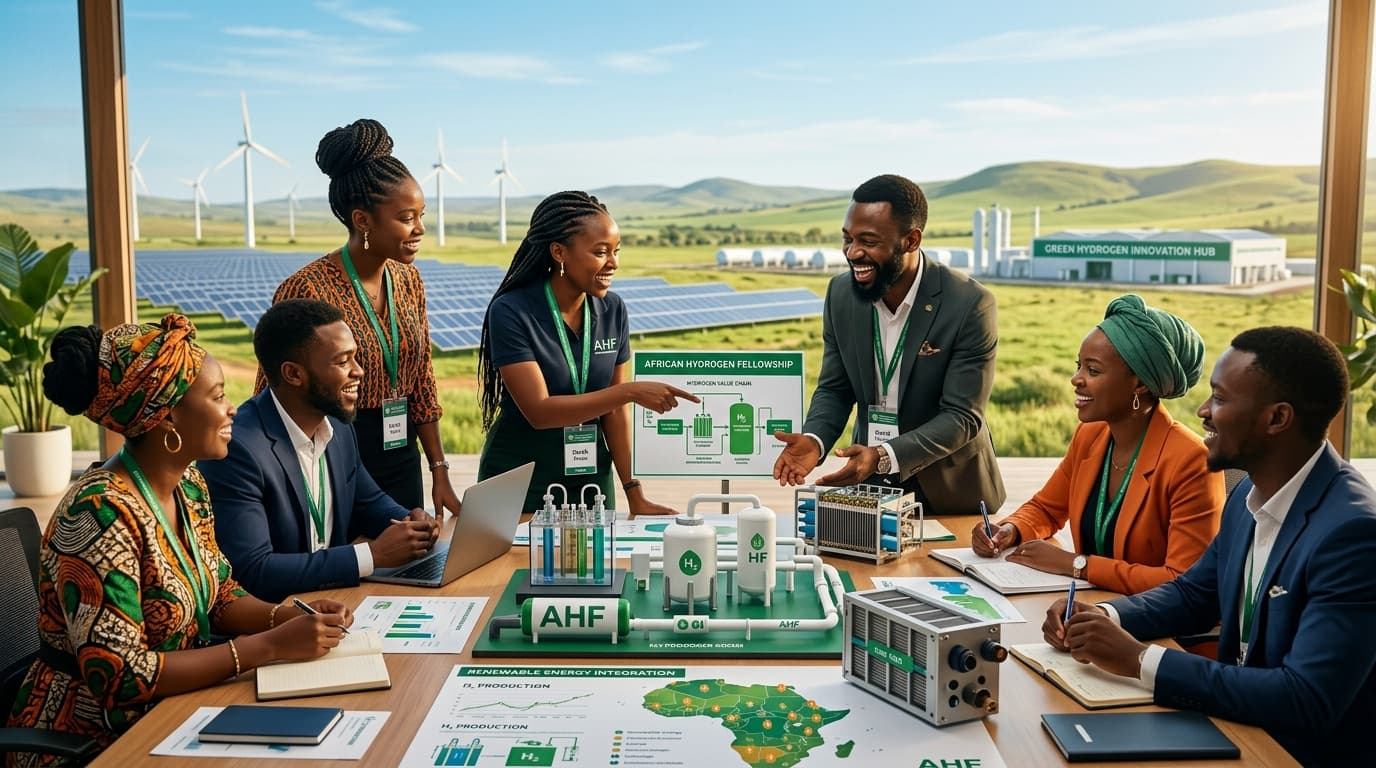
CrossAfrique Hydrogen Facilitates African Hydrogen Fellowship Sessions on Practical Hydrogen Pathways for Africa
Between January and May 2026, the CrossAfrique Hydrogen team facilitated a series of sessions under the African Hydrogen Fellowship, contributing to the development of practical hydrogen knowledge for emerging professionals, researchers, and energy practitioners across Africa.
The sessions were designed to move the hydrogen conversation beyond general enthusiasm and into practical system thinking. For CrossAfrique Hydrogen, this is essential. Africa’s hydrogen opportunity should not be understood only through the lens of future exports, but also through energy access, industrialization, food security, infrastructure resilience, and domestic value creation.
Across the fellowship, the CrossAfrique team facilitated sessions covering the foundations of hydrogen, hydrogen production pathways, industrial applications, environmental considerations, and the role of hydrogen within integrated renewable energy systems.
The first session introduced the definition, significance, historical development, and basics of hydrogen production. A central message was that hydrogen is an energy carrier, not an energy source. Its real value depends on how it is produced, how it is transported, and where it is ultimately used. The session also helped participants understand that hydrogen’s strengths and weaknesses are inseparable. Its high gravimetric energy density makes it attractive for certain applications, but its low volumetric density, infrastructure requirements, and safety considerations mean that it must be deployed carefully and strategically.
The second session focused on hydrogen properties, applications, and environmental considerations. One of the key messages was that demand-side choices matter. For African energy systems, the question is not simply whether hydrogen can be produced cleanly, but whether it is being used where it creates real system value. Hydrogen should be prioritised in areas where direct electrification is difficult, including industrial feedstocks, high-temperature processes, heavy transport, logistics, and long-duration energy storage.
The third session explored industrial applications of hydrogen. Participants examined how green hydrogen can support the decarbonization of sectors such as fertilizer, steel, refining, petrochemicals, and chemical manufacturing. These are sectors where hydrogen is not only an energy carrier, but also a molecular feedstock or chemical reductant. This makes hydrogen particularly important in areas where electricity alone cannot easily replace existing industrial processes.
For CrossAfrique Hydrogen, this discussion is central to Africa’s development agenda. Africa’s hydrogen strategy should not be limited to supplying raw green molecules to external markets. It should also support domestic value creation through green fertiliser, cleaner industrial production, resilient supply chains, and hydrogen-based industrial clusters.
The fourth session focused on hydrogen as part of integrated energy systems. The CrossAfrique team guided participants through the role hydrogen can play alongside solar, wind, batteries, and smart energy management systems. The session examined hydrogen’s relevance for grid balancing, off-grid and weak-grid solutions, and long-duration storage for critical users such as healthcare facilities, telecom towers, mining operations, agricultural processors, and industrial sites. A key message from the session was that batteries and hydrogen should not be framed as competing technologies. Batteries are well suited for short-duration balancing, fast response, and daily energy shifting. Hydrogen becomes more relevant where energy systems need resilience over longer periods, including extended outages, multi-day storage, and seasonal variability.
This systems perspective reflects CrossAfrique Hydrogen’s broader approach to project development. Africa’s energy future will not be built around one technology. It will require integrated solutions that combine renewable power, storage, hydrogen, smart controls, and bankable business models.
Through its facilitation of the African Hydrogen Fellowship sessions, CrossAfrique Hydrogen contributed to strengthening the next generation of African hydrogen thinkers and practitioners. The focus was not on promoting hydrogen as a universal solution, but on helping participants understand where hydrogen can create the greatest practical value.
For Africa, that value lies in using hydrogen strategically: to strengthen energy resilience, support industrial transformation, enable food security, decarbonize hard-to-abate sectors, and unlock new pathways for sustainable development.